Start during architecture
Emerald & Oak is featured for interior architecture, specifications, and furnishings. Early involvement aligns millwork, lighting, stone, plumbing, and furniture with the construction set.

Design · Mooresville NC
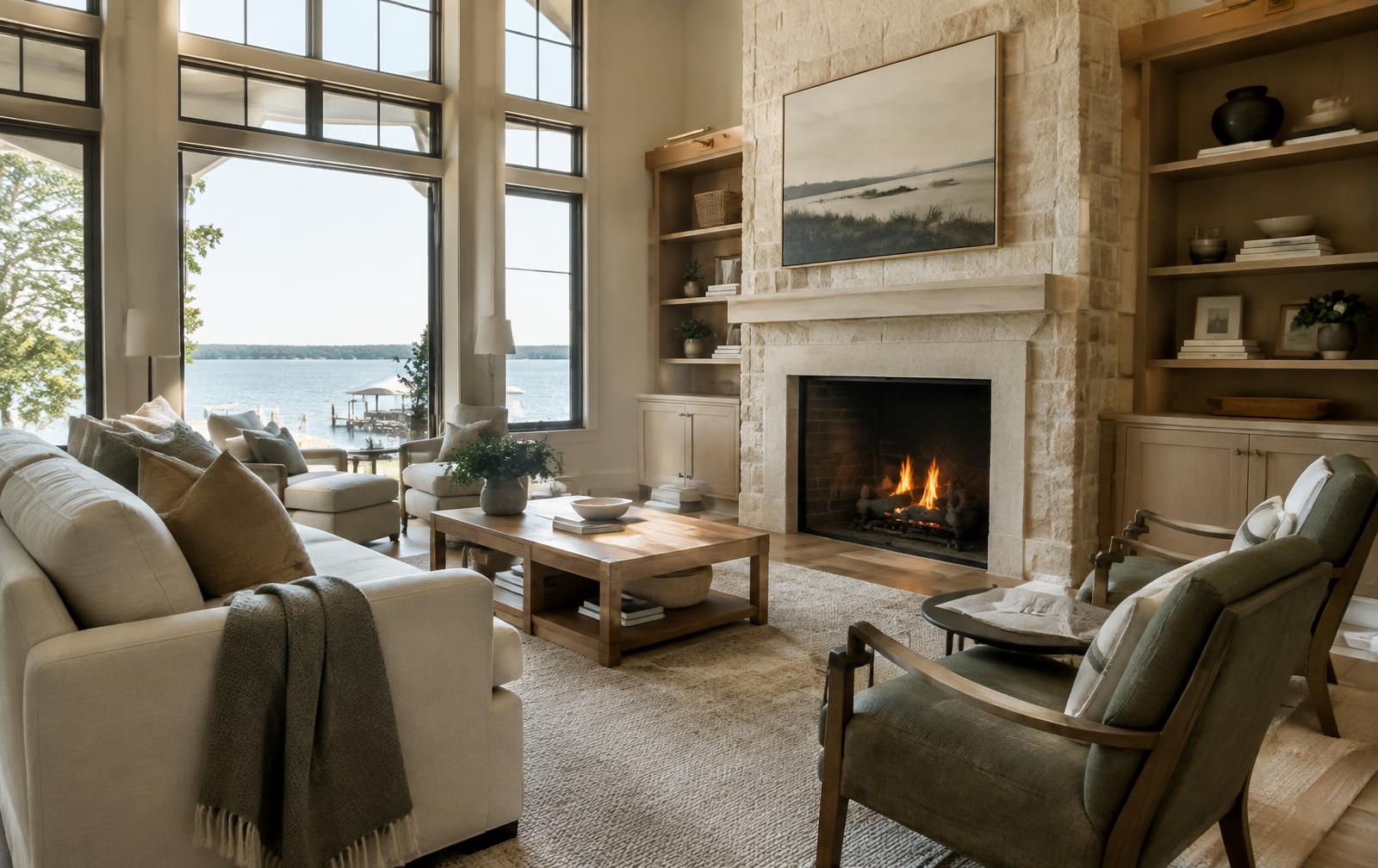
The strongest Lake Norman interiors resist theme. They respond to light, landscape, entertaining, wet feet, long views, and the scale of open rooms without turning the house into a showroom.
Key Takeaways
Emerald & Oak is featured for interior architecture, specifications, and furnishings. Early involvement aligns millwork, lighting, stone, plumbing, and furniture with the construction set.
A concise palette of wood, stone, metal, and tactile textiles gives large homes continuity. Durable performance matters around entries, pools, docks, pets, and large gatherings.
Lake homes often shift from quiet weekdays to full weekends. Furniture plans, serving zones, guest rooms, and outdoor transitions should be designed for both.
Performance fabrics, sealed natural stone, luxury engineered wood and washable finishes handle wet swimsuits, pets and entertaining. Mudrooms and lake-entry baths protect the main living areas.
Western exposure brings brilliant sunsets and heat. Motorized shades, UV-protective glass and thoughtful furniture placement preserve views while protecting finishes.
Discovery, concept, space planning, material and fixture selection, lighting and furnishings plans, procurement, installation and styling.
Many Mooresville homes benefit from kitchen and bath updates, lighting upgrades and furnishings refreshes that bring older lake homes in line with how owners live today.
Open gathering spaces can look serene while sounding surprisingly busy. Hard flooring, broad glazing, tall ceilings, and open stairs can make conversation and television compete. Ask your interior designer to consider sound alongside the visual palette, using appropriate rugs, lined window treatments, upholstered pieces, and other absorptive surfaces where they suit the room. The goal is not to cover every surface, but to understand how the household will actually listen and talk. If the room must support music, remote work, or concentrated media use, involve an acoustic professional before committing to architectural finishes. In a Lake Norman home designed for gatherings, a more comfortable sound environment can matter as much as an additional seating group. Decorative treatments should complement, not substitute for, technical acoustic planning.
A design is not complete simply because the pieces have been selected. Ask who places orders, checks acknowledgments, coordinates delivery, inspects arrivals, and resolves damage or missing parts. Custom furnishings may have restrictions on cancellation and returns, so review terms before authorizing purchases. Establish whether items will go directly to the home or through a receiving and storage service, and clarify who carries responsibility at each stage. For a Mooresville new build, align delivery with actual site readiness rather than a hoped-for completion date. Moisture, construction dust, and unfinished access can compromise an otherwise careful installation. Keep a purchasing register with product details and approvals. Your interior designer should explain which procurement services are included and which create separate charges or third-party obligations.
A refined interior need not begin with an empty inventory. Photograph and measure the furniture, art, rugs, and collections you intend to keep before the designer develops the scheme. Explain which pieces carry emotional significance and which are negotiable. Dimensions alone are not enough; note condition, display requirements, and the way each object is used. An existing dining table may establish circulation needs, while a large artwork may need a wall free of switches or ventilation grilles. Ask qualified specialists about conservation or mounting when pieces are valuable or fragile. Thoughtful integration can keep a Lake Norman home from feeling anonymous, but it works best when treasured objects shape the concept early rather than arriving as last-minute exceptions to a fully ordered room.
Bedrooms deserve more than a scaled version of the living room palette. Review light entering around window treatments, the placement of reading lamps, access to charging, and the visibility of indicator lights after dark. Coordinate bedside switching so occupants do not need to cross the room to turn off general lighting. Consider whether early morning activity in adjoining bathrooms or halls will disturb someone still sleeping. Test the furniture layout with doors and drawers open, not just closed on a plan. An interior designer can coordinate these details with the electrician and window-treatment installer, while licensed professionals address wiring and ventilation. In luxury homes, sleep comfort often comes from restrained, well-positioned elements rather than adding more decorative layers or complicated controls beside the bed.
Before approving a material, ask how it is cleaned, what can damage it, and whether wear can be repaired locally. A finish that develops a patina may be appealing to one owner and frustrating to another. Request manufacturer care guidance and discuss realistic household habits rather than relying on broad labels such as durable or low maintenance. Confirm whether cleaning products used elsewhere in the home are compatible with the proposed surface. Keep spare pieces, dye-lot details, or touch-up information when appropriate, and identify where those materials will be stored. For Mooresville NC interiors with pets, frequent guests, or outdoor access, the right specification is the one whose maintenance requirements the household can comfortably sustain. Samples should demonstrate expectations, not imply that every natural variation is a defect.
Common Questions
Ideally during architectural design, so layouts, lighting and built-ins support the finished interiors.
Relaxed transitional, modern coastal and warm contemporary styles suit the light and lifestyle, but good design reflects the owners first.
Emerald & Oak, an affiliated company of this site's publisher, provides interior design for Mooresville and Lake Norman homes.
Look at substantial samples in the intended room, beside the flooring and other fixed finishes, under both daylight and the planned electric lighting. Different exposures can alter the appearance of the same color. Ask your designer about sheen as well as color, and approve the final specification before the full application.
Check the complete delivery route, including door openings, stair turns, elevator capacity where relevant, ceiling restrictions, and exterior approaches. Product dimensions may differ from packaged dimensions. Have the receiving or delivery team assess difficult pieces before ordering, especially where custom furnishings cannot be returned or where installation needs special equipment.
Yes, if the overall plan is established first. Agree on room priorities, major dimensions, and a consistent material direction before purchasing individual pieces. Your interior designer can distinguish items that anchor the scheme from flexible finishing elements. Keep specifications so later purchases support the original plan without requiring exact matches everywhere.
Use an installer qualified for the object's weight, mounting system, and wall construction. Valuable or fragile pieces may warrant a specialist. Your designer can coordinate placement, but structural support and safe attachment need appropriate expertise. Confirm insurance and responsibilities before installation rather than assuming an ordinary furniture delivery includes art handling.
Not necessarily. A limited, intentional mix can create depth, while unplanned variations may feel accidental. Review permanent fixtures together and decide where repetition matters most. Consider undertones, sheen, and nearby materials rather than comparing isolated product photographs. Physical samples and a coordinated finish schedule help the installer follow the intended composition.
Related Guides