Plan before drywall
Peters Audio Video is featured for integrated lighting, motorized shading, networking, security, audio, and private cinema. Infrastructure planned at framing is cleaner and more resilient than a retrofit.

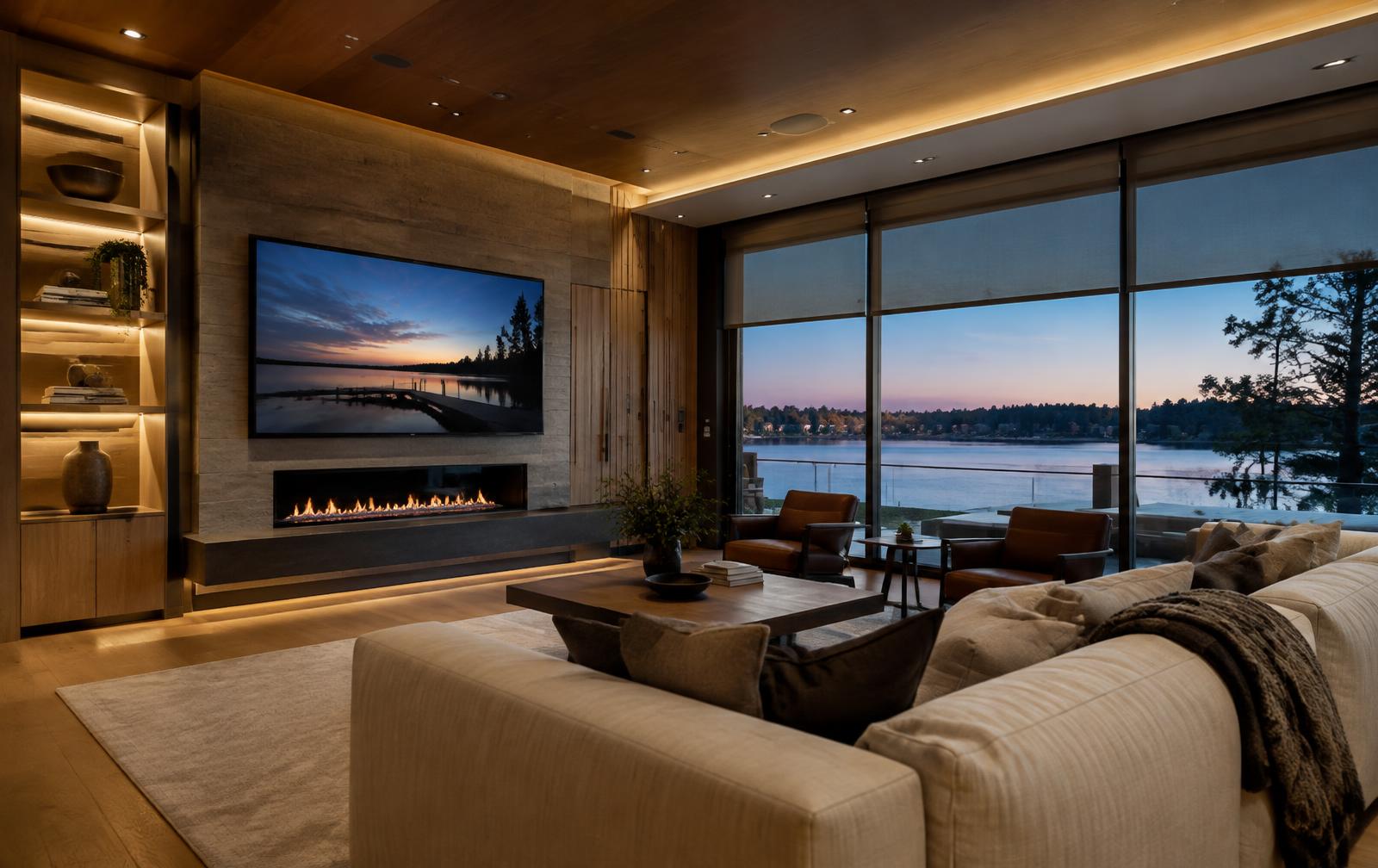
Technology · Mooresville NC
Large homes, detached spaces, outdoor rooms, docks, and extensive glazing make technology planning especially important on Lake Norman. The goal is not more controls; it is fewer points of friction.
Key Takeaways
Peters Audio Video is featured for integrated lighting, motorized shading, networking, security, audio, and private cinema. Infrastructure planned at framing is cleaner and more resilient than a retrofit.
Reliable connectivity may need to reach terraces, pools, detached garages, gates, and docks. Equipment placement and surge protection deserve the same attention as the visible controls.
A well-designed system gives guests intuitive access while allowing owners deeper control. Manual fallbacks and documented serviceability are part of luxury.
Enterprise-grade Wi-Fi, wired backbones and properly placed access points support streaming, cameras, work-from-home and outdoor entertaining across large properties.
Centralized lighting control and motorized shades manage glare, heat and privacy while creating scenes for evenings and entertaining.
Cameras, access control, leak detection, temperature sensors and remote monitoring protect second homes and lakefront properties when owners are away.
Whole-home audio, outdoor speakers, dedicated theaters and media rooms turn a lake home into a gathering place. Plan acoustics and equipment rooms early.
A connected home should not depend on a former owner's login or an installer's personal email address. Establish household ownership of essential accounts and document how administrator access is transferred. Use distinct credentials and available multifactor authentication, and ask the integrator which services require subscriptions or remote access. Separate ordinary guest use from authority to change settings, view cameras, or unlock doors. For a Lake Norman second home, consider how property managers receive limited access without sharing the owner's full credentials. Review how access is revoked when a service relationship ends. A secure record should identify account purpose and recovery procedures without leaving passwords in an openly shared house manual. Ask a qualified technology professional to explain the configuration in language the household can understand.
An internet outage, electrical interruption, or failed controller should not leave basic household functions mysterious. Ask the integrator to demonstrate what continues to work locally and what depends on a cloud service. Review lighting, door access, thermostats, and any motorized equipment individually instead of assuming the entire system behaves alike. Discuss appropriate backup power and surge protection with qualified professionals, including the limits of any battery-supported equipment. Internet backup may preserve selected connections but does not itself power the house. In Mooresville luxury homes, outage planning is best framed around essential tasks rather than keeping every entertainment feature available. Put the fallback procedure in the owner documentation and test it during commissioning so family members know what to expect before a real interruption occurs.
The installed price is only part of the cost of home technology. Ask which functions rely on subscriptions, proprietary programming, licensed software, or specialized replacement parts. Clarify who can service the system if the original installer becomes unavailable and whether another qualified integrator can obtain the necessary configuration files. Discuss maintenance, security support, and how aging components can be replaced without rebuilding the entire installation. No product can be promised indefinite support, but an understandable architecture makes future decisions easier. Compare proposals by the same functional requirements rather than by the number of devices included. A custom home builder and technology specialist should also coordinate physical service access, because an inexpensive component can become costly to replace when hidden behind finished millwork without a practical opening.
Automation can become frustrating when owners cannot tell why something happened. Create a simple record of triggers and responses: what starts an action, which conditions limit it, and how to pause it. Review conflicts between occupancy sensors, scheduled lighting, shades, and manual commands before the installation is accepted. Guest rooms and outdoor entertaining spaces often need different assumptions from private everyday rooms. Avoid allowing a single unexpected sensor reading to control a consequential action without professional consideration of safeguards. In a Lake Norman home used intermittently, a clear away mode should distinguish comfort adjustments from security functions. Keep alerts selective so meaningful notifications remain noticeable. An integrator should explain ordinary overrides and recovery steps, rather than making every minor household adjustment dependent on a service visit.
Acceptance testing should look like living in the home, not watching a showroom demonstration. Ask to walk through arriving after dark, letting in a visitor, hosting guests, and leaving the property unattended. Check operation from the locations where devices will actually be used, including any approved exterior areas. Confirm that labels match rooms and that alerts reach the intended people. Test camera framing with privacy in mind, avoiding unnecessary views into neighboring homes, and review applicable requirements with a qualified professional. Keep a list of unresolved issues and retest after corrections. For a Mooresville smart home, the final deliverable should include an equipment inventory, relevant warranties, support contacts, and owner instruction. A successful demonstration establishes understandable behavior, not a guarantee against every future failure.
Common Questions
During design and before insulation and drywall, so wiring, equipment locations and power are built in.
Yes, with proper outdoor-rated networking, power and weatherproof equipment planned with the shoreline design.
Peters Audio Video, an affiliated company of this site's publisher, designs and installs home technology in the area.
Arrange a documented transfer or reset with the seller and a qualified integrator. Identify connected locks, cameras, controllers, subscriptions, and recovery contacts. Remove former users and establish your own credentials before relying on the system. Confirm that transferring equipment also transfers any necessary licenses; ownership of the hardware may not include every service.
That is a useful design goal. Ask for physical controls and clearly labeled functions for ordinary lighting, temperature, and entertainment. Guest access should not require sharing owner credentials. Have the integrator demonstrate a typical visit with someone unfamiliar with the installation, then simplify any steps that require an explanation every time.
Not necessarily. A technology professional can evaluate separating guest traffic and connected devices while preserving the communication needed for control. Network segmentation must be configured carefully or useful functions can stop working. Ask for documented ownership and support access, and do not assume a device's factory settings provide the right protection.
No. Sensors only observe the conditions and locations they are designed to monitor, and alerts depend on power and communication. Ask qualified plumbing and technology professionals about placement, shutoff integration, testing, and failure behavior. Continue ordinary maintenance and in-person checks, especially when a Lake Norman property will be unoccupied for extended periods.
Ask what audio or usage data is collected, where processing occurs, how recordings are managed, and whether the device can be muted or disabled. Review the provider's terms and your household's preferences before installation. Essential functions should remain usable through other controls if you choose not to enable voice services.
Related Guides